Chirality @ Bath Chemistry
Overview
Circular Dichroism (CD) spectroscopy allows the determination of chirality in solution or solid state. A chiral molecule absorbs preferentially either right- or left-handed circularly polarised light, with the difference giving rise to the CD spectrum. This technique is extensively used to study protein and DNA folding, supramolecular interactions, and the behaviour of chiral molecules under a wide range of conditions.
Optical Rotatory Dispersion (ORD) spectroscopy measures the difference in the rotation of linearly polarised light caused by differences in the refractive index of circularly polarised light. ORD measures the variation in optical rotation with wavelength and can be used to determine the absolute configuration of metal complexes and other chiral species. In the literature ORD is also called Circular Birefringence (CB); it can be derived from CD via Kramers-Kronig transform method.
Linear Dichroism (LD) spectroscopy measures the difference between the absorption of polarised light travelling parallel and perpendicular to an orientation axis. It is mainly used for studying macromolecules with ordering in solution or the solid state.
Circularly Polarised Luminescence (CPL) allows the study of the excited states of chiral molecules. It provides unique information about excited-state geometry that complements CD spectroscopy.
Useful References
- Analysis of the kinetics of folding of proteins and peptides using circular dichroism Nature Protocols
- Using circular dichroism spectra to estimate protein secondary structure Nature Protocols
- Determination of the folding of proteins as a function of denaturants, osmolytes or ligands using circular dichroism Nature Protocols
- Using circular dichroism collected as a function of temperature to determine the thermodynamics of protein unfolding and binding interactions Nature Protocols
Facilities
The facility contains two spectrometers capable of measuring chirality in solution or thin films: an Applied Photophysics Chirascan and two Jasco J-810.
Applied Photophysics Chirascan
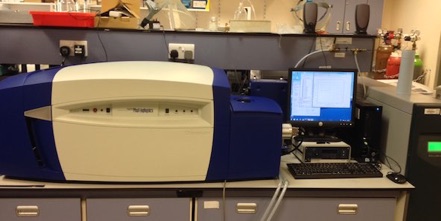
Specifications
- N₂-cooled 150 W Xe arc lamp (UV-vis) & 100 W tungsten/halogen lamp (NIR)
- Avalanche photodiode detector (UV-vis) & InGaAs photodiode detector (NIR)
- Spectral range: <170 nm to 1700 nm
- Dual polarising, dual dispersing monochromator
- Peltier-controlled 4-cell autochanger (QNW)
- Temperature range: -20 °C to 110 °C
- Rectangular cells, maximum width 10 mm
- Thin-film measurements in transmission and reflection modes
- 0.1 nm wavelength resolution throughout the spectral range
- Detection modes:
- Circular Dichroism (CD)
- Absorbance
- Linear Dichroism (LD)
- Optical Rotatory Dispersion (ORD)
- Fluorescence
- Fluorescence Detected Circular Dichroism (FDCD)
- Temperature
- Detector HV and DC voltage
- Automatic titration accessory using a Hamilton MicroLab 500 dual syringe dilutor/dispenser
- Can accommodate circular cells in a single Peltier-controlled cell holder
- Compatible with OptiStat DN variable-temperature cell holder and controller (-190 °C to 220 °C)
Circularly Polarised Luminescence (CPL) Accessory
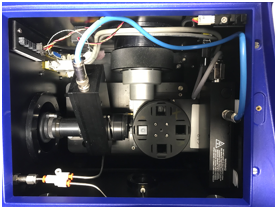
- Software-controlled dedicated SEM
- Spectral range: 205 nm to 800 nm
- Enables CPL measurements for studying excited-state chiroptical properties
- Cooled Red sensitive PMT detector for 800 nm to 1100 nm detection
- Temperature range: -20 °C to 110 °C (standard) and -190 °C to 220 °C (with OptiStat DN)
Jasco J-810
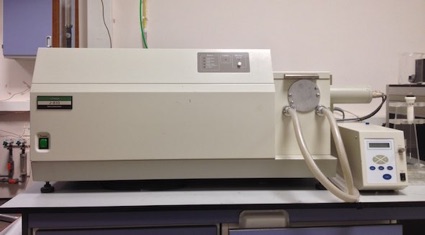
Specifications
- N₂-cooled 150 W Xe arc lamp
- Spectral range: 190 nm to 900 nm
- Peltier-controlled single-cell holder
- Temperature range: -5 °C to 110 °C
- Rectangular cells, maximum width 10 mm
- Thin-film measurements in transmission and reflection modes
- 0.1 nm wavelength resolution throughout the spectral range
- Detection modes:
- Circular Dichroism (CD)
- Absorbance
- Fluorescence
- Fluorescence Detected Circular Dichroism (FDCD)
- Temperature
- Detector HV
- Can accommodate 100 mm rectangular cells
- Pellet accessory for measuring CD through thin solid samples
- Compatible with Specac variable-temperature cell holder and controller
- Solid samples: -190 °C to 250 °C
- Liquid samples: -70 °C to 250 °C
Jasco CD-2095 Plus HPLC CD Detector
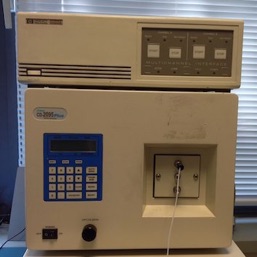
This dedicated HPLC circular dichroism detector allows simultaneous CD and absorbance detection at a single variable wavelength.
Specifications
- 150 W Hg-Xe arc lamp
- Spectral range: 220 to 420 nm
- Bandwidth: 20 nm
- Wavelength accuracy: ±3 nm
- CD output range: 0.5 to 1280 mdeg
- 25 mm flow cell (44 μL)
- Maximum operating pressure: 30 bar
- Can record a complete spectrum (220-420 nm) in non-automatic mode
- Currently controlled through ChemStation using an Agilent 35900 A/D converter
- Compatible with a wide range of HPLC systems using suitable A/D converters
- Additional control via Python script
Jasco OR-1590 Optical Rotation Detector
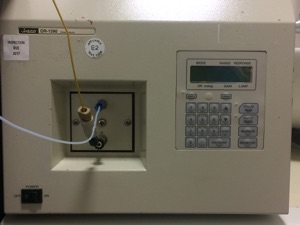
A dedicated chiral HPLC detector operating over an extended wavelength range.
Specifications
- 150 W Hg-Xe arc lamp
- Spectral range: 350 to 900 nm
- Angular range: ±500 mdeg
- 25 mm flow cell (44 μL)
- Maximum operating pressure: 30 bar
- Attached to Agilent LCMS via Agilent 39500E A/D interface
- Can also be used with DATAQ DI-149 and other A/D acquisition interfaces
Contact
For access to instrumentation, experimental support, or collaborative projects involving CD, ORD, LD, CPL, or chiral HPLC detection, contact GDP.
Last modified: 26 August 2026.